You should establish a cadence of drills that fits your setting, ranging from 1–2 safety drills annually to monthly childcare evacuations or full-scale school exercises, with annual active shooter readiness. Ascertain clear signage and color-coded floor plans, including wheelchair-accessible routes and pictographs for non-English speakers. Build inclusive egress with accessible doors, lighting, and trained disability experts. Include pet safety, loading practice, and pet-friendly shelters. Use data to drive improvements, and you’ll uncover practical safety enhancements you can apply today.
Cadence of Evacuation Drills Across Settings

Across settings, the cadence of evacuation drills is shaped by context and risk, balancing regular practice with the realities of each environment.
You’ll see drill frequency vary: Communities hold one to two safety drills annually, with annual readiness for active shooter events and additional exercises driven by local hazards.
Childcare facilities perform monthly evacuations, including naptime drills and off‑peak sessions to fit long operations.
Schools involve responders in initial tests, with lockdowns and full-scale exercises that engage partners for realistic evacuation simulations.
Workplaces adjust frequency according to plan reviews and training needs, incorporating outside resources and post‑drill evaluations.
For USACE projects, frequency follows federal guidance, emphasizing preparedness strategies and timely alerts to guarantee coordinated action with local authorities.
Regular fire drills enhance speed and safety during real emergencies, ensuring families and communities are well-prepared for unexpected situations.
Signage, Communication, and Written Procedures
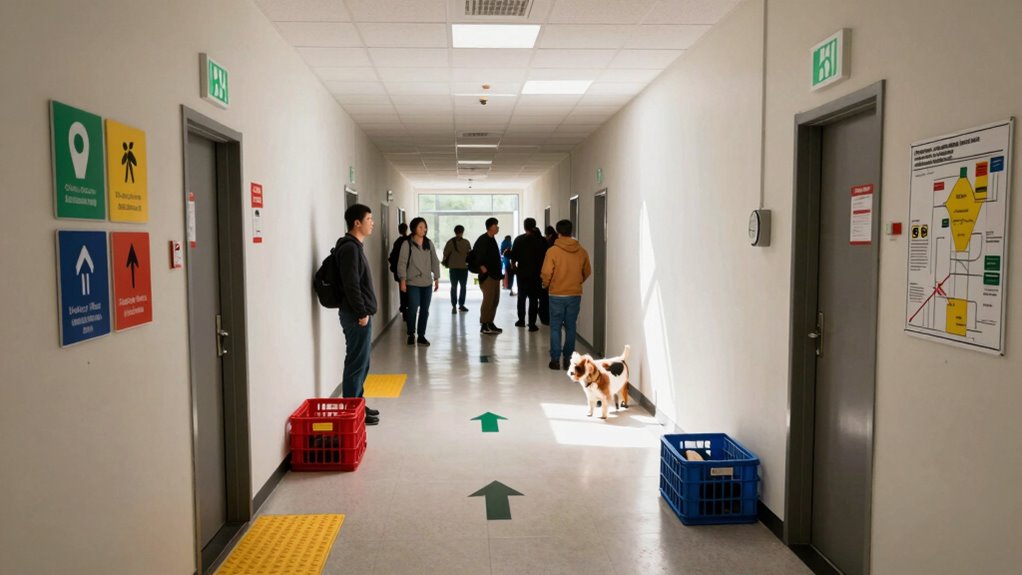
Signage, communication, and written procedures form the backbone of a coordinated evacuation. You rely on clear exit signs that indicate the nearest safe route, including wheelchair-accessible paths, and color-coded floor plans showing primary and secondary routes, exits, and stairways. Pictographs assist non-English speakers, posted at regular intervals in hallways and elevator lobbies. Pathway markings and disability-specific signage aid evacuation for all occupants. Highly visible, reflective signs point to emergency shelters. The emergency communication system admin handles drill notifications, with audible announcements ten minutes before programs and coded messages for asleep patients after visiting hours. Written procedures comply with OSHA, local, and international codes, and are available in electronic, large print, and Braille formats. Smoke alarms on every floor are crucial in early detection and increase the chances of safe evacuation during a fire. Signage effectiveness and communication clarity underpin every safe exit.
Accessibility and Inclusive Egress Design

Assuring accessibility and inclusive egress design means proactively embedding disability-informed considerations into every phase of evacuation planning.
You implement pre-planning accessibility by detailing evacuation protocols and identifying individuals needing assistance, inspecting doorways, automatic doors, handles, lighting, and wheelchair space, and reviewing site access for para-transit and public transport usability.
You include disability experts in safety officer coordination and guarantee protocols account for disabilities when selecting drill locations.
In transportation integration, you secure agreements with accessible providers and nearby jurisdictions, maintain a 24/7 on-demand contact, and incorporate community-based organizations’ vehicles and drivers, offering free services during operations.
For evacuation route design, you verify wheelchair accessibility of exits, provide audible alarms with flashing lights, Braille, and large text, and map barrier-free pathways.
You emphasize universal design and clear egress pathways.
Pet and Animal Considerations in Community Drills
Pet and animal considerations are integrated into community drills to confirm that pets, livestock, and other animals are accounted for alongside human safety. You practice loading into pet carriers, reinforcing calm entry through crate training, and coordinating with neighbors to assign animal safety roles. Drills include livestock transport planning, such as trailer loading for horses, to reflect real evacuation needs. Assemble pet kits with food, water, medications, veterinary records, and collars, and store them for quick access during swift evacuations. Ascertain identification is current, with ID tags and rescue alert stickers indicating pet counts and vet contacts. Pre-identify pet-friendly shelters and routes, and designate roles that support both human and animal safety during emergencies. Regular fire drills are essential to ensure preparedness and smooth execution of evacuation plans, including the well-being of pets and livestock.
Assessing Effectiveness and Data-Driven Improvements
Data-driven evaluation should begin with clear, measurable objectives that align to your drill goals; this guarantees you can track progress and pinpoint gaps.
In evaluating effectiveness, you use data analysis to convert observations into actionable insights. Track performance metrics such as response times, evacuation durations, and resource availability to determine how closely actual deployment matches the plan.
Collect participant feedback through post-drill evaluations to reveal knowledge gaps and improvement needs. After-action reports document what worked and what didn’t, providing thorough analyses for refinement.
Attendance and participation tracking confirms staff presence, while real-time performance monitoring enables immediate adjustments during drills.
Use historical data and simulation results to benchmark and drive continuous quality improvement across quarterly or higher-frequency exercises.
Wrapping It Up
You should implement regular evacuation drills across all settings, maintain clear signage and written procedures, and guarantee communication remains accessible to every participant. Design for inclusive egress, considering mobility, cues, and staggered flows to prevent congestion. Include pets and animals in planning where appropriate, with shelter and evacuation guidance. Collect data after each drill to refine cadence, routes, and signage. Use findings to drive continuous improvements in safety training, response times, and overall community resilience.