Vents, gutters, and roof edges are key ember entry points you can control. Use soffited-eave designs aligned with wind flow and install 1/8-inch mesh screens to limit ember size and quantity. Maintain gutters to prevent debris ignition, and choose noncombustible flashing and edge barriers to block ember intrusion. Regular inspections keep seals intact and gaps closed, reducing entry at roof-wall intersections. Unvented attic strategies can eliminate entry points altogether. If you keep going, you’ll learn more about practical protections.
Ember Entry Through Vents: What Works

Ember entry through vents is a central concern in wildfire resilience, and understanding which vent designs minimize risk helps you make informed choices.
Ember entry via vents is a key wildfire resilience concern guiding design choices.
You should evaluate vent types by how wind interacts with their faces; perpendicular orientations invite embers, while soffited-eave designs, aligned with wind flow, reduce entry compared with open-eave configurations.
When wind hits a vent directly, it becomes an inlet—even if it’s intended as an outlet—so location matters.
Incorporate ember resistance through 1/8-inch mesh screens to limit ember size and quantity, and consider unvented attic strategies where feasible to eliminate entry points altogether.
Remember that mesh helps but doesn’t guarantee full protection, so combine proper vent placement with resistant materials for best results.
Defensible space around homes is critical for fire prevention, as it reduces the risk of fire spreading from surrounding vegetation to the structure, thus enhancing overall wildfire resilience.
Gutters and Debris: Keeping Ignition at Bay
Gutters and debris pose a significant ignition risk that homeowners can actively reduce. Embers easily ignite pine needle debris and bark mulch accumulated in gutters, regardless of gutter material type.
Vinyl gutters detach from fascia and spread burning material to the base of exterior walls when debris inside ignites, while metal gutters often stay in place but expose fascia and roof sheathing to prolonged flame contact.
Burning debris in gutters can ignite wood shake roofing near the roof edge, making gutter vulnerability one of the most significant fire hazards around homes.
Regular gutter maintenance, including routine clearing of leaves, needles, and debris, is a simple, low-cost step to improve wildfire safety and reduce fire hazards. Incorporating fire-resistant materials into your home design, such as using metal roofs and ember-resistant vents, can significantly enhance your home’s ability to withstand wildfires.
Roof Edges: Barriers Against Ember Penetration
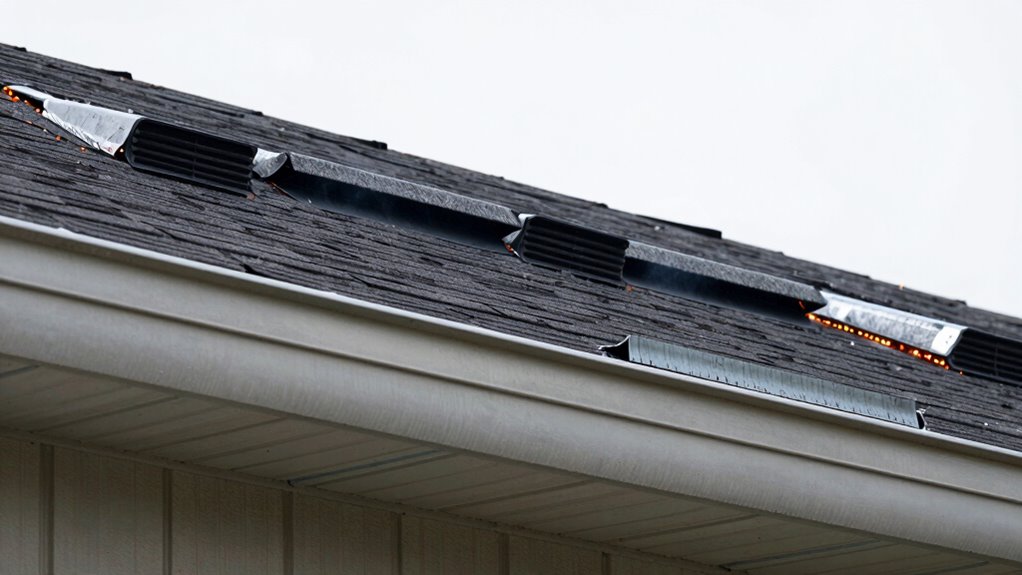
Roof edges with proper barriers reduce ember penetration by sealing gaps, installing non-combustible flashing, and employing edge protections that guide embers away from vulnerable joints. You’ll consider how different ember penetration modes—wind-driven transfer, surface spotting, and ember lodging at seams—interact with edge design and materials. Effective edge protection strategies combine sealing, metal flashing, and resilient materials to create a continuous ember defense at eaves, fascias, and roof-to-wall junctions. A comprehensive understanding of defensible space strategies supports the effectiveness of roof edge protections by ensuring the surrounding environment minimizes ember accumulation and exposure.
Roof Edge Barriers
Metal flashing at roof edges and intersections forms a robust line of defense against ember intrusion, creating sealed, continuous barriers that prevent embers from entering vulnerable areas.
You benefit from these barriers when flashing materials are properly installed to seal edges, blocks embers, and reduce ignition risk. Aluminum or copper flashing helps protect the roof perimeter, supporting edge ignition resistance in fire-prone conditions.
Sealed edges work with Class A roofing to minimize ignition chances, and closing gaps under tiles or shingles blocks ember entry. Regular maintenance of roofs and gutters prevents fire hazards, ensuring that edge barriers remain effective over time. Regular inspection keeps edge gaps from expanding, while edge sealing is essential for fire-retardant wood decking.
Proper installation maximizes protection, enhances durability, and complements maintenance programs aimed at sustaining ember resistance. Sealing techniques must be precise for reliable performance.
Ember Penetration Modes
Are there distinct ways embers penetrate roof-edge barriers that engineers should anticipate? Yes.
Ember movement patterns concentrate at roof-to-wall intersections where debris accumulates, so ignition risk factors rise there. Debris-laden edges trap embers and ignite accumulated combustibles before they reach deeper structural elements, making edges critical for mitigation. The termination points of flashing and the seams between roof and wall define pathways for ember entry, especially when complex roof forms like dormers create additional intersection zones. Fire beneath the roof can spread rapidly yet remain unseen from outside, emphasizing the need for thorough edge protection and clean components. Proper flashing, sealed gaps, and regular maintenance disrupt ember flows and reduce penetration potential at vulnerable junctions.
Regular monitoring of the effectiveness of these protection measures ensures that vulnerabilities are promptly addressed, thus minimizing fire-related risks.
Edge Protection Strategies
Edge protection at the roofline is critical for limiting ember entry, and effective strategies start with robust barriers at joints and edges. You should consider metal drip edges that are noncombustible, protecting the roof edge and preventing flames from reaching attic or cathedral ceilings. Aluminum or copper flashing at roof edges reduces ignition risk, and guarantee metal angle flashing is used if a gutter is hung below the roof edge. This edge reinforcement also benefits from proper flashing at intersections to secure changes and block ember entry from burning gutter debris. Regularly inspect gaps between tiles and sheathing; plug openings with bird stopping to prevent ember nests. Implementing fire sprinkler systems can further enhance roof protection by providing rapid suppression of embers that may land on the structure.
Retardants: How They Protect Surfaces Post-Application
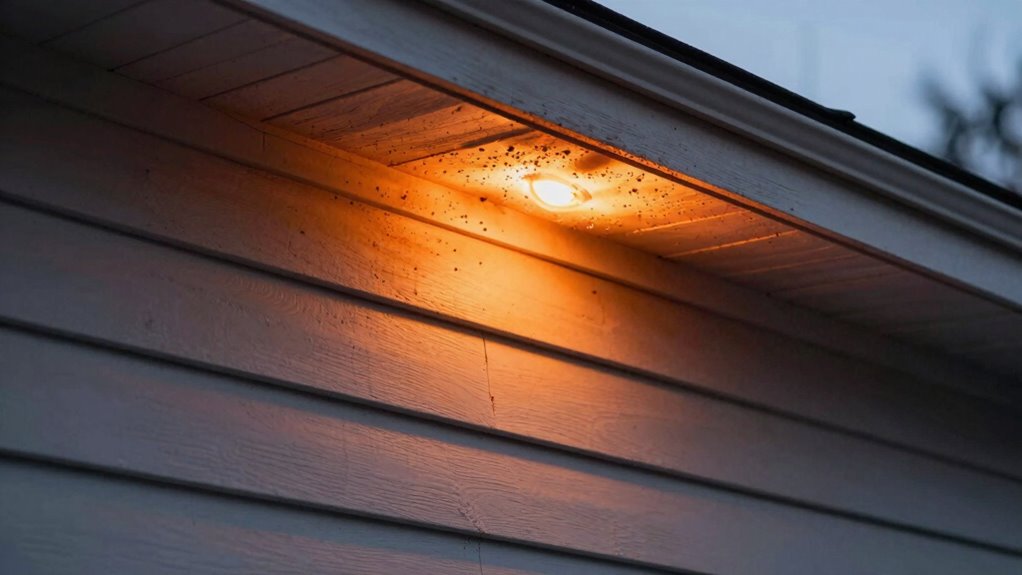
Post-application, your surfaces maintain a residual guard as the coating slowly continues to act, extending protection beyond the initial cure.
The persistence of surface chemistry matters, with active compounds and char-forming layers lingering to slow heat transfer and dilute combustible gases.
Activation timing can be tuned, offering flexibility to accommodate project schedules and environmental conditions while still meeting safety performance goals.
Post-Application Residual Guard
Post-application residual guards provide a second line of defense by continuing to protect surfaces after the initial coating or treatment has cured. You rely on residual effectiveness to slow heat release, reduce flames, and extend evacuation time when exposure occurs. Phosphorus compounds release PO• radicals as they thermally decompose, neutralizing reactive species and lowering flame propagation. Salts alter combustion after water evaporation, decreasing fire intensity for 30 to 120 minutes, while intumescent coatings form heat-activated char that insulates the surface. Coatings expand or release suppressants to lower surface temperatures and cut smoke production. APP-based formulations preserve structural stability by delaying temperature rise, supporting longer protection windows. Guarantee application consistency to maintain the intended thickness, minimizing cracking and preserving residual effectiveness over time. Regular inspections verify sustained performance. Fireproofing services are crucial for enhancing the fire resistance of materials, providing crucial time for evacuation and firefighting efforts during emergencies.
Surface Molecular Persistence
Surface molecular persistence refers to the enduring presence and activity of retardants at the material’s surface after application, which governs how protection continues during and after initial cure.
You’ll see surface integrity improve as a char-forming layer develops from phosphorus-based compounds, forming a protective crust that resists mass transfer.
Molecular stability arises when organosilicon retardants migrate to the surface, creating a cracked carbon layer with enhanced oxidation resistance.
Intumescent systems add compact char barriers rich in C, N, and P, further stabilizing the surface.
Dehydrating action promotes carbonaceous layers through cyclization and cross-linking, sustaining protection as temperatures rise.
Activation Timing Flexibility
Activation Timing Flexibility refers to how retardants adjust fire-protection performance after application under varying conditions.
You’ll see gel products remain active for hours, providing an immediate mitigation effect as surfaces cool and form protective barriers. The intumescence layer forms in about 20 seconds and strengthens with weathering, extending protection to over 60 seconds after three months.
Gas-phase inhibition from phosphorus-containing retardants persists, influencing ember dynamics even as radiant exposure changes. Higher heat flux shortens the delay to flaming, yet coatings at 50 kW/m² still increase ignition time by about 49 seconds, while 70 kW/m² yields a 27-second improvement.
Obstructions and ventilation shifts, along with ambient oxygen, alter activation timing and ember movement, underscoring the need for integrated safety design.
Prevention Strategies That Boost Survival
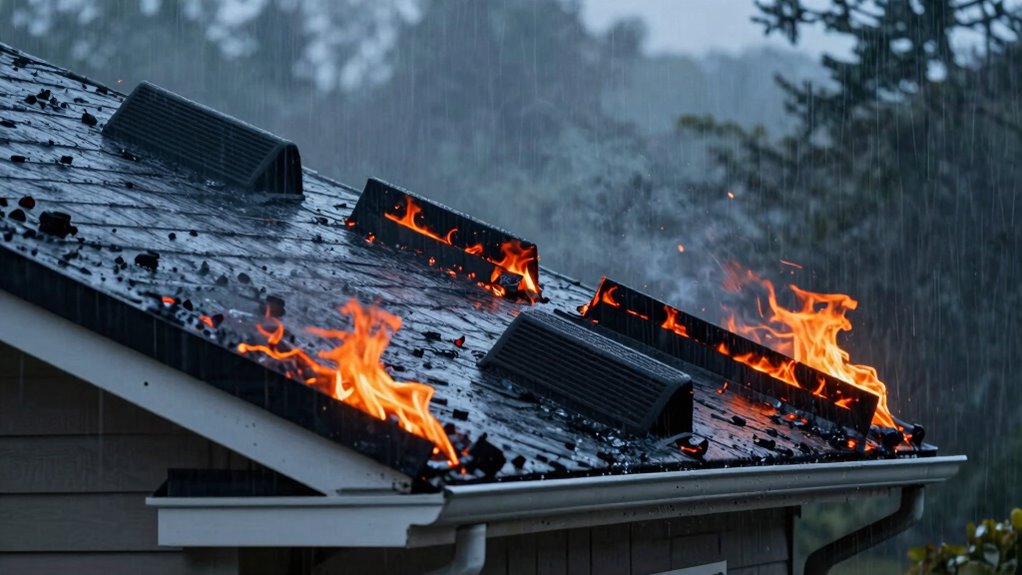
Prevention strategies that boost survival center on reducing ignition opportunities and limiting fuel availability around assets. You reduce ignition risk by supporting education campaigns that discourage careless behaviors and promote fuel reduction, which lowers unintentional starts.
Implement defensible space through vegetation management, creating vegetation-free zones that slow wildfire advance and provide buffers for firefighters. Thinning tree canopies helps prevent crown fire spread, while removing dead wood and debris reduces fuel loads near structures.
Implement defensible space via vegetation management: create fuel-free zones, thin canopies, and remove dead wood near structures.
Implement fuel management within defensible space to mitigate fire intensity, and adopt fire resistant materials where possible to further limit ignition likelihood. Coordinated early detection and collaboration with local agencies enhance rapid response, ensuring containment before structures face intensive heat.
This approach emphasizes prevention, planning, and disciplined maintenance.
Real-World Outcomes: Evidence for Hardened Homes
Studies of recent wildfires show that home hardening and defensible-space practices yield substantial real-world gains in survivability.
In this section, you’ll see how hardened homes perform under real fire exposure and why survival strategies matter beyond theoretical models. Data show that combining vegetation clearing within Zone Zero with non-combustible siding, enclosed eaves, and vent screens dramatically lowers losses, with up to 48% fewer damages when paired together.
A 5-foot vegetation perimeter alone reduces losses by 17%, while overall structure survivability improves when hardening accompanies proper spacing and fire exposure management.
Post-1997 building codes also contribute, as newer homes resist ignition more effectively.
In practice, these findings confirm that rigorous hardening and defensible space translate into meaningful, measurable reductions in destruction and enhanced community resilience.
Wrapping It Up
You can reduce ignition risk by prioritizing ember control where it matters most. Guarantee vents have tight screens and protective barriers, and maintain gutters clear of debris to prevent flame contact. Treat roof edges with appropriate barriers and ignition-resistant materials, and consider retardants for exposed surfaces after treatment. Combine these measures with ongoing maintenance and rapid debris removal to improve survivability. Real-world outcomes show that integrated strategies boost home resilience during wildfire exposure. Stay proactive, informed, and vigilant.