Turn wildfire priorities into work the board can authorize and verify
An HOA wildfire mitigation plan should turn a community assessment into named tasks, approved spending and a repeatable maintenance process. For each location, record who can authorize the work, which budget will fund it, who will perform it and who will check completion. A cleanup day can help; a work register keeps unresolved tasks from disappearing between meetings.
This guide focuses on assigning, budgeting and tracking common-area work for Los Angeles HOA communities. The original tools below are planning examples for a homeowners association, to be adapted to its property, governing documents and professional advice.
Start with a risk assessment that identifies specific work
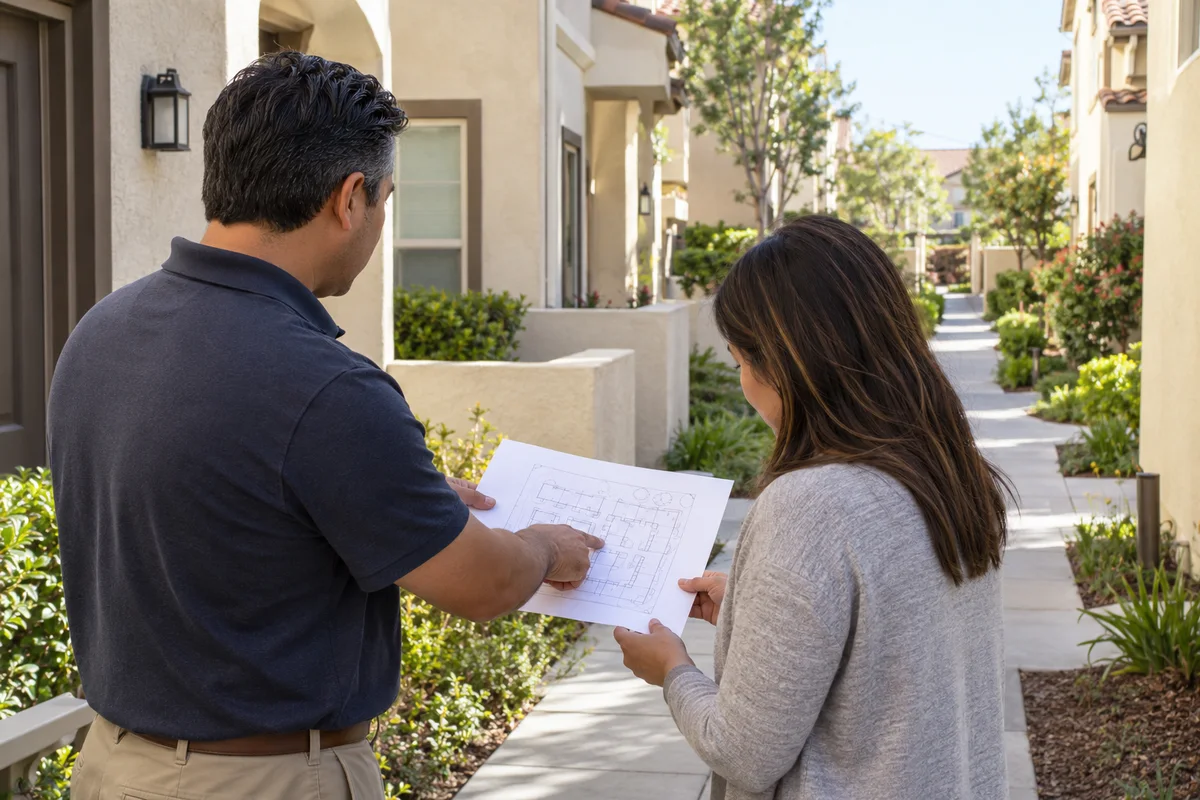
Ask the assessor to give each observed issue a location and task number. “Reduce wildfire risk along the north common slope” needs a defined area, proposed action and any design questions before contractors can price it. Map the common land, individual homeowner parcels, access routes and boundaries requiring joint review.
Keep technical findings brief in the board register: vegetation management, a connected fuel pathway, an ember vulnerability or an access concern. Attach the assessment rather than rewriting it into every work order. For roof, gutter and other home hardening details, refer to our ember-defense guide. Use our brush-clearance guide for the separate notice and agency process.
How should an HOA board assign common-area mitigation work?
Confirm responsibility before requesting entry or authorizing changes. California Civil Code section 4775 addresses association, separate-interest and exclusive-use common-area maintenance, with important exceptions based on the declaration. A fence, planting bed or private walkway should not be assigned by appearance alone. Check the governing documents and records, and resolve uncertainty with the appropriate advisers.
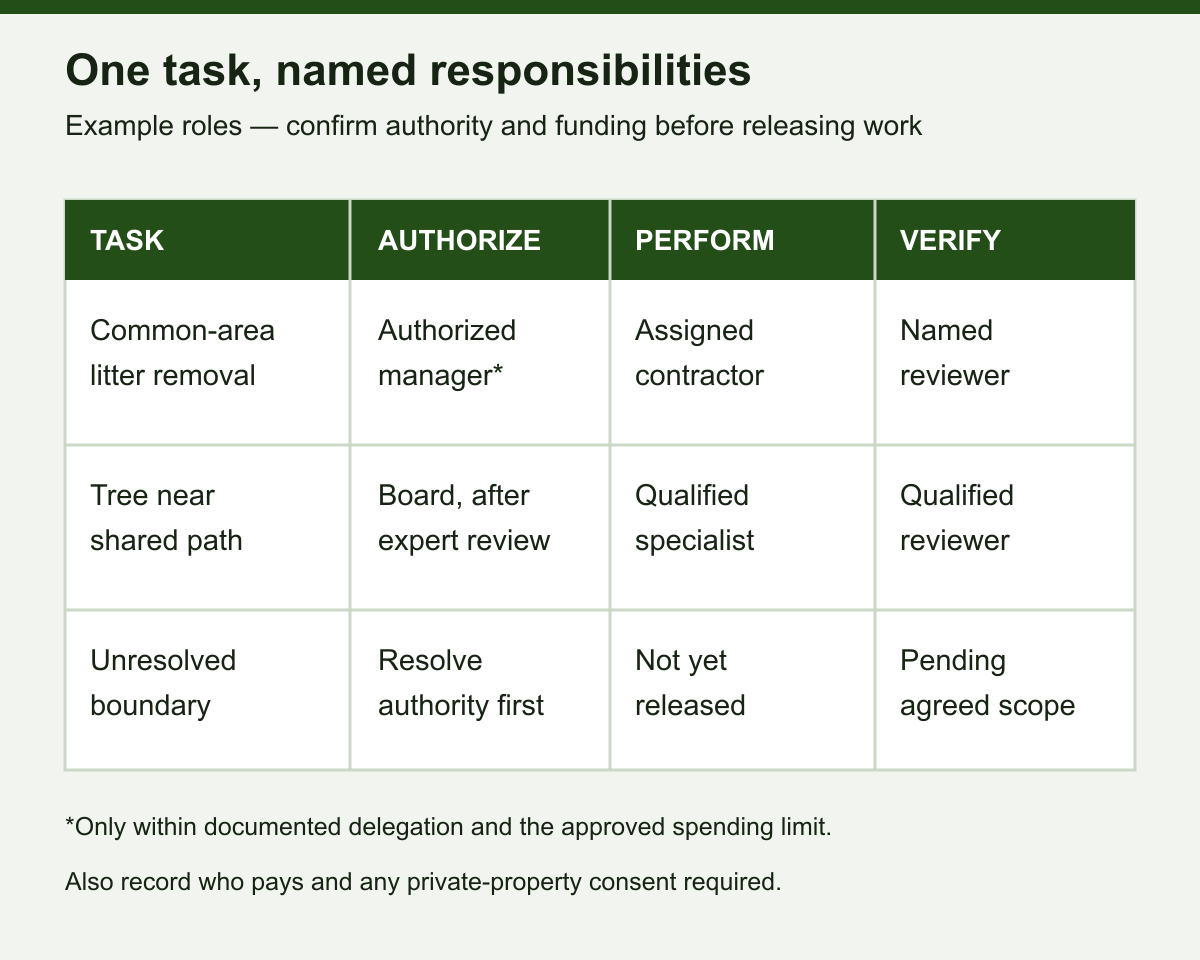
Give every task four decisions:
| Decision | What to record |
|---|---|
| Authorize | The person or body with authority, required consent and the approval reference. |
| Fund | The confirmed funding source, allocation and any spending limit. |
| Perform | The assigned contractor, staff member or participating property owner and the agreed scope. |
| Verify | The named reviewer, acceptance criteria and completion evidence. |
These roles can belong to different people. Individual homeowners may need to authorize work on their land, while an authorized manager coordinates an association contractor. If responsibility is unresolved, name the person obtaining the answer and set a review date. “Neighbors to coordinate” is not an assignment.
Which wildfire mitigation work should HOAs fund first?
Have the qualified assessor distinguish high-priority exposure from routine maintenance and work that needs specialist design. Keep agency-required corrections and their deadlines visible. A board preference does not extend an ordinance deadline or replace an instruction from the responsible fire department.
For each task, show both priority and readiness. A high-risk area may need arborist or drainage advice before work can start. Meanwhile, an approved litter-removal task may be ready to release. Phase connected fuel reduction tasks together so one unfinished boundary does not undermine the surrounding work. For a fence connection, use our fire-resistant fencing guidance for that technical detail.
Build a phased budget for the wildfire mitigation plan
Separate assessment and design, initial project work, disposal, verification and recurring visits. Obtain site-specific quotes. Track an allocation approved for planning separately from a commitment under a contract, an invoice and an actual payment. This prevents the same balance from appearing available twice.
Hypothetical budget example: an association has a $12,000 planning ceiling after confirming its funding and approval process. It allocates $8,000 to a defined first work package, $2,000 as an allowance for specialist review and leaves $2,000 unallocated for decisions not yet resolved. The total is $12,000. These numbers illustrate accounting categories; they are not FPLA prices, market estimates or a recommended contingency percentage.

Before releasing a phase, record the scope, maximum authorized amount, funding source, decision reference and who can approve a change. If the quote exceeds the allocation, return the difference to the board’s process rather than quietly reducing the scope. Ask separately what recurring vegetation work will cost to maintain.
Confirm the money is available for that purpose
Do not assume a positive reserve balance is unrestricted project cash. Civil Code section 5510 restricts reserve spending to specified purposes involving the association’s major components. Have management, accounting and legal advisers confirm the appropriate funding and approval route. Keep a prospective wildfire mitigation grant or other grant funding separate from money actually awarded and available; check its conditions before committing costs.
Give contractors the same common-area work package
Use task numbers and a marked site plan in every bid request. Specify boundaries, quantities, access arrangements, disposal, site protection, required qualifications, exclusions and evidence expected at completion. Identify protected trees, slopes, utilities and other features requiring review before disturbance. A broad request to thin vegetation or create a fuel break is not a complete construction scope.
Ask bidders to price dependencies and optional phases separately. Name who may authorize changes and require written agreement before extra work begins. Explain access impacts to residents and identify the contact who can resolve an issue during the job.
Track completion without confusing it with acceptance
Keep one register for the entire community, with a task ID, location, issue, scope, responsible parties, funding, target date, status, evidence link and next review. A simple shared spreadsheet can work if access and version ownership are clear.
- Proposed: observed and logged; scope or authority still needs review.
- Approved: scope, funding and required permissions are confirmed.
- Released: the named contractor or owner has an agreed start and finish window.
- Completed: work is reported finished, with dated evidence attached.
- Verified: the assigned reviewer has checked it against the agreed scope.
- Recurring: the next maintenance task and responsible person are recorded.
For example, task N-03 might identify an association-maintained strip beside a gate. Its record would name the authorized vegetation-management scope, contractor, reviewer and next inspection date. Link the before-and-after photos, invoice and review note to N-03 rather than scattering them across email.
A board representative’s completion check is different from a local fire department accepting a required correction or a specialist signing off technical work. Record which kind of verification occurred. The work register documents decisions; it does not certify wildfire safety or guarantee an insurance outcome.
Maintain a calendar that survives a change of board
Build review dates around the property’s growth, weather, contractor cycles and agency instructions. A planning example is a monthly open-task review, a seasonal vegetation and access check, and an annual budget and board handoff. Inspect for new debris after wind events only when access is safe. These are sample management intervals, not a universal fire-code schedule.
At handoff, transfer the current map, open decisions, committed costs, vendor contacts, evidence folders and next review dates. Confirm that the new task owner has access. Set a clear route for residents to report a new concern.
Keep wildfire preparedness connected through the existing community evacuation-drill guide. This work program does not replace evacuation routes, emergency management instructions or residents’ departure decisions.
Keep broader community programs clearly identified
An internal wildfire protection plan is not automatically an approved Community Wildfire Protection Plan (CWPP), which has its own collaborative and approval process. Likewise, Firewise USA recognition in California has separate criteria. Track those commitments explicitly if they are association goals.
Ask for an assessment with an implementation handoff
FPLA’s WUI fire protection services include HOA and community coordination support. A property fire-risk assessment can help identify priorities for a community in the wildland-urban interface. Ask for findings that can be translated into scoped tasks, dependencies and a maintenance plan.
Contact FPLA with the site layout, known maintenance responsibilities and the board’s project goals. The useful next step is a risk-reduction program the association can authorize, fund, verify and maintain.
California source pages checked October 21, 2026. Confirm the requirements and authority applicable to the association.